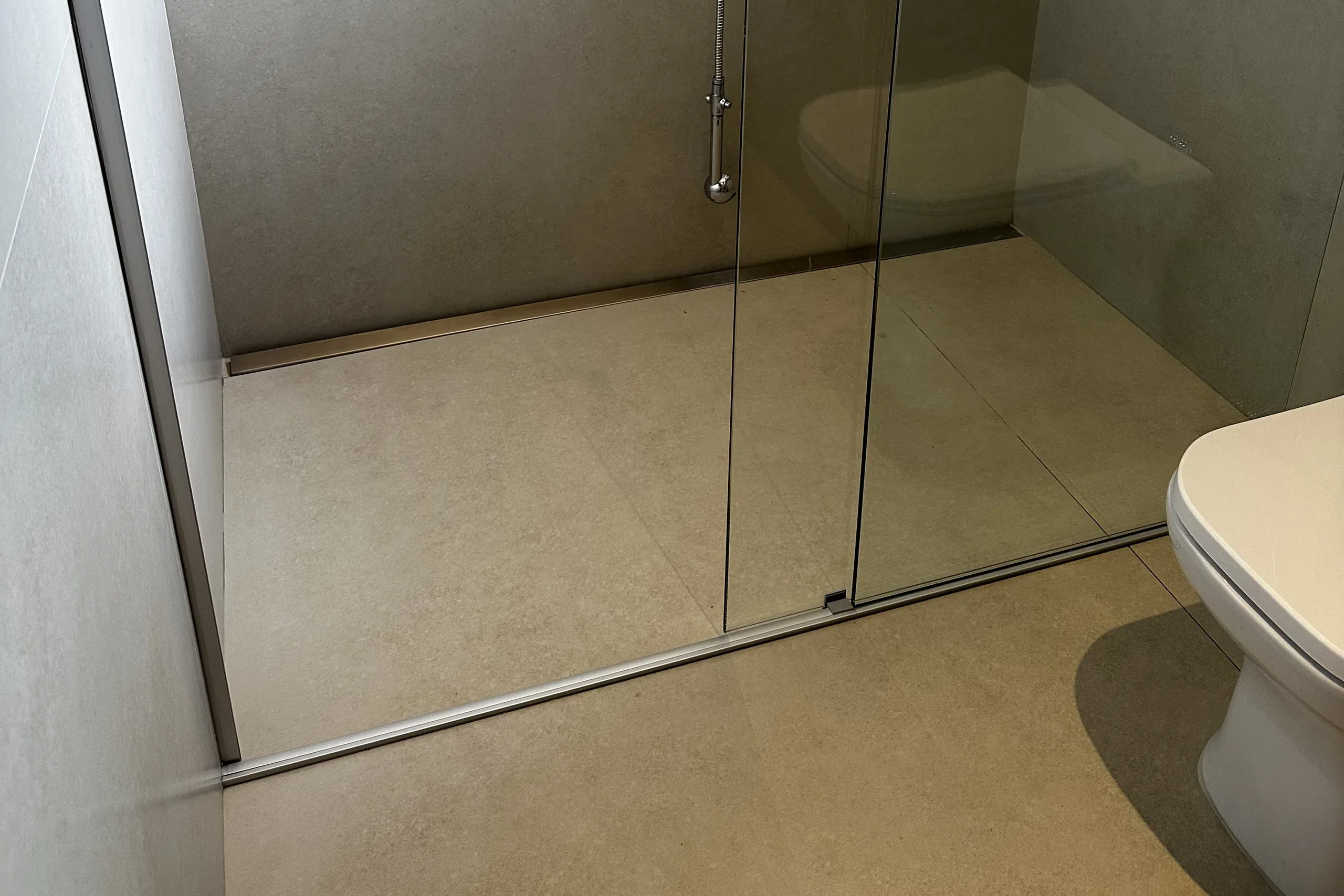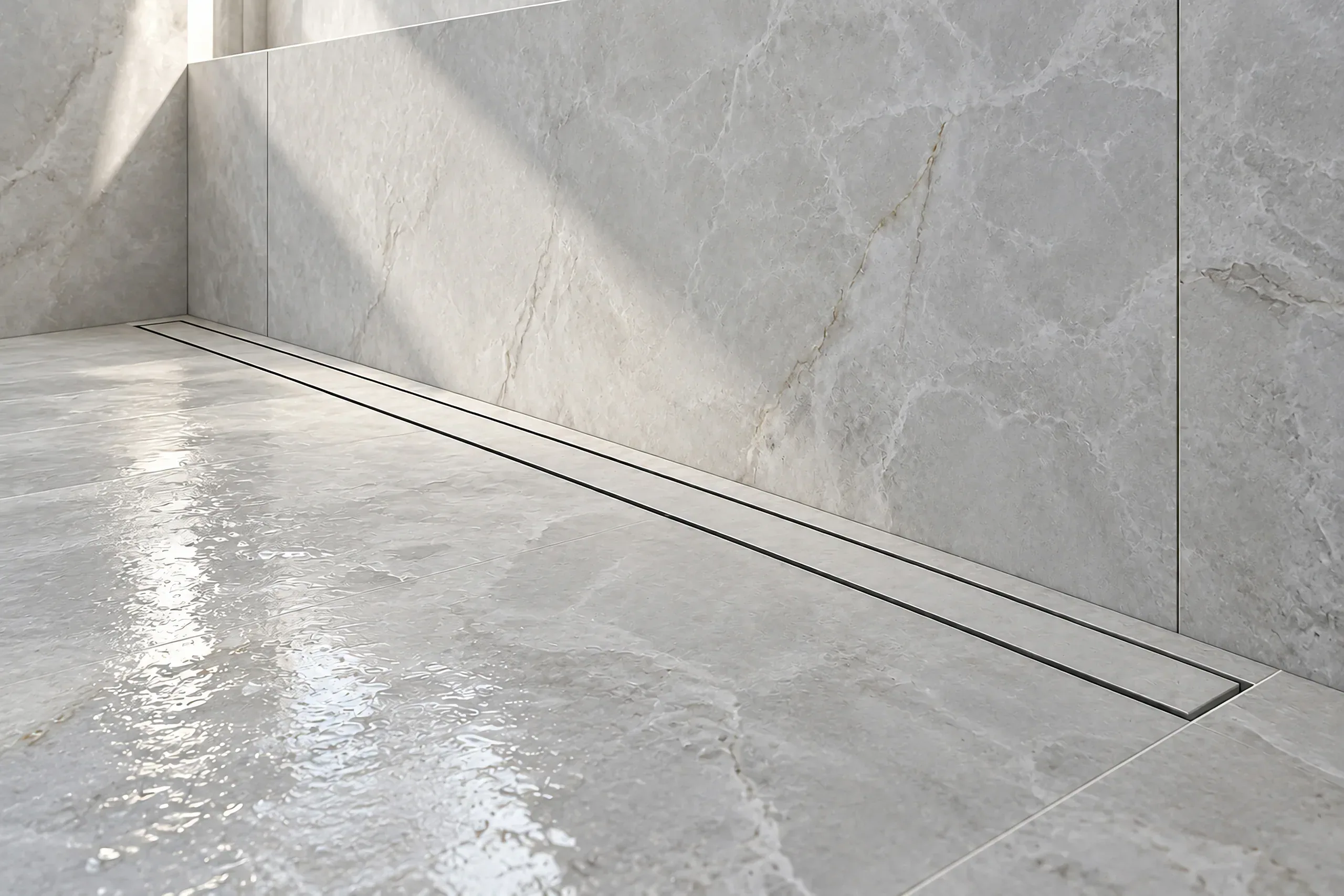

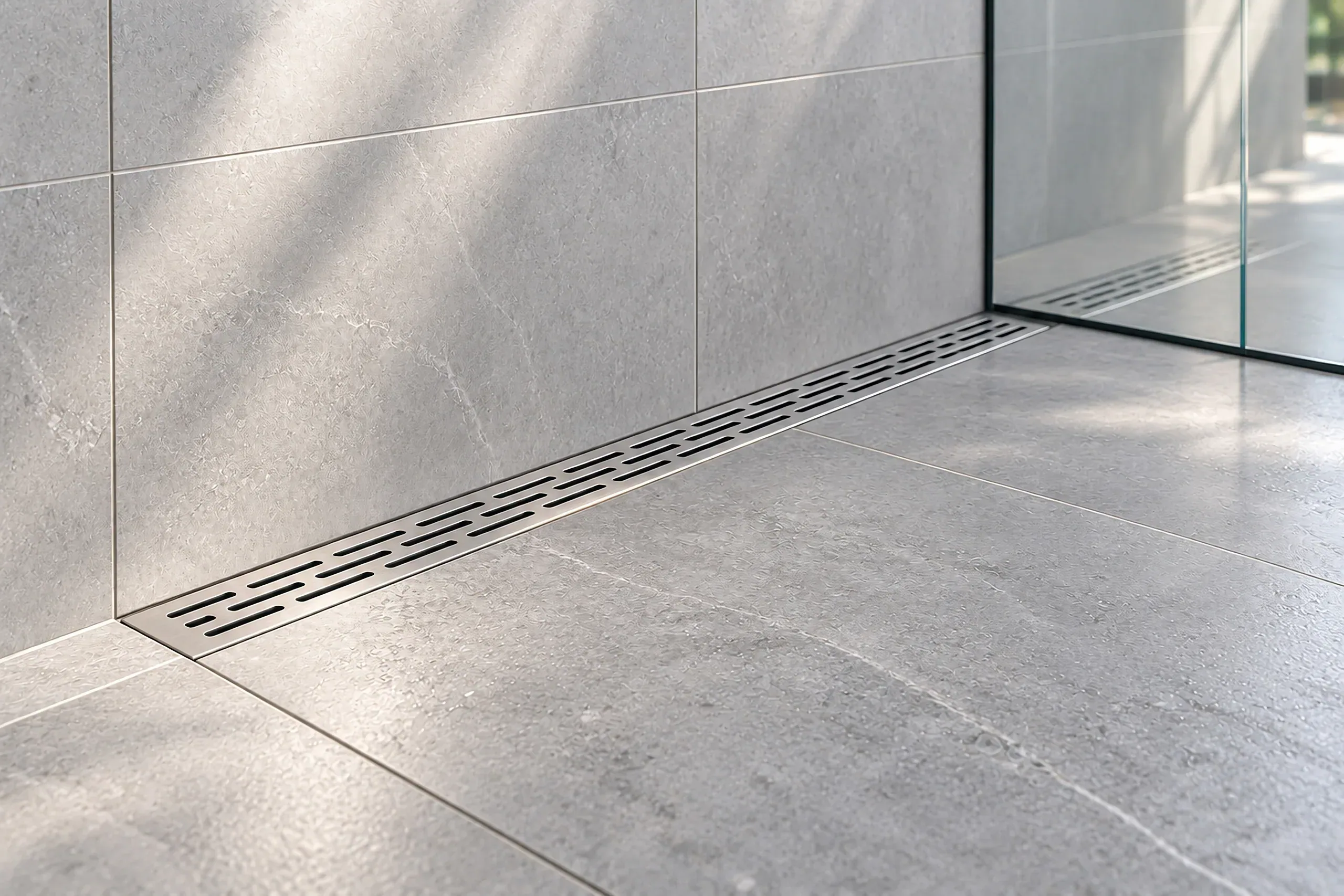
The right linear shower drain is the one that matches what you want to see on the shower floor. For a continuous floor, choose the tile-insert drain. For a grate with a pattern, the perforated drain. For a thin line, the Slim. Below you can compare each Art Ralos model and see which one suits your project.
Tile-Insert Linear Drain: the porcelain tile runs over the drain
The Tile-Insert Linear Drain is the choice for a clean shower. The finish takes a strip of the same porcelain tile as the bathroom. No stainless steel shows on the floor: only the tile strip and four thin gaps around it, where the water enters.
For the architect, the result is a shower with no visual break. For the homeowner, it is a drain that disappears into the floor. It is made of 304 stainless steel, base included, and comes with a screen that helps keep out larger insects.
At the job site, set aside a leftover piece of the bathroom tile to use on the drain. The strip sits flush with the floor and the drain ends up with the same pattern as the room.
Hidden aluminum drain: the Basic
The Basic Aluminum Linear Drain is also a tile-insert linear drain for the bathroom, in painted matte aluminum, in light gray, black and brown. A strip of the same floor tile sits between thin trims, with a slot along each long side where the water enters.
It needs a channel 7 cm wide and is for use inside the shower only. It is a hidden aluminum option when the project calls for that material.
Perforated Linear Drain: a stainless steel grate with a pattern
On the Perforated Linear Drain, the stainless steel grate stays visible and has a laser-cut pattern. There are five options: Bubble, Flat, Flower, Grid and Square. Every pattern is also available in black.
The grate lifts out for cleaning: take it out, remove what is stuck and put it back. It is a good fit for a shower with glass and a neutral floor, where the grate becomes a finishing detail.
Solid Stainless Linear Drain: a smooth surface
The Solid Stainless Linear Drain has a smooth surface, in brushed stainless steel or matte black. Water enters through the gaps on both sides of the strip. It suits those who prefer the metal in sight, with no pattern, in a straight line along the shower.
Slim Linear Drain: a 3 cm line on the floor
The Slim Linear Drain is the narrowest linear bathroom drain from Art Ralos, 3 cm wide. The channel is aluminum with black paint and the finish is 304 stainless steel, polished or black. The Standard model has a smooth surface and water enters through the side gaps. On the Perforated model, water passes through square holes.
It works for a small shower or for a project where the drain should almost disappear. It comes with an insect screen.
Square shower drains: Small, Click and Open-Close
When the drain point is a siphon box, the option is a square drain, inside or outside the shower:
- The Small Square Drain comes in 10, 15 or 20 cm, in Tile-Insert, Solid Stainless, Black and Perforated models. Inside, a removable basket catches debris.
- The Click Pop-Up Drain opens and closes with a touch of the foot, in 10 or 15 cm. When closed, it helps hold back odors and keep out insects.
- The Open-Close Floor Drain has a perforated disc that turns. With the holes aligned, water passes. Turning the disc closes the opening. It comes in 10 or 15 cm, in polished stainless steel.
Linear drain sizes and outlet
Linear bathroom drains run from 50 to 120 cm in length. The Tile-Insert, Perforated, Solid Stainless and Slim drains come in steps of 10 cm, and the first three need a channel 6 cm wide. Other sizes are made to measure for your project.
On the 6 cm drains, the outlet has five positions: center or side, down or sideways, or at the end of the channel. On the Slim, the outlet is central or lateral. Define the outlet before closing the floor, according to the sewer point. Need help measuring? See the measurement guide.
Where to install the linear drain in the shower
Install the drain straight and parallel to the wall or the glass, inside the shower. The floor must slope toward the drain, and the top sits flush with the tile. On drains with a flange, the flange goes under the tile. The installation manual shows each step.
Which linear drain to choose
- Continuous floor, no metal in sight: Tile-Insert Linear Drain.
- A strip of floor between thin painted trims, in aluminum: Basic Aluminum Linear Drain.
- Stainless steel grate with a pattern: Perforated Linear Drain.
- Smooth stainless or black surface: Solid Stainless Linear Drain.
- A 3 cm line: Slim Linear Drain.
Frequently asked questions
What is the best linear shower drain?
It depends on the finish you want. The Tile-Insert Linear Drain is the most discreet, because it takes the same floor as the bathroom. The Perforated and Solid Stainless drains leave the metal in sight. The Slim is the narrowest.
Does a hidden shower drain clog more?
The hidden drain receives water through the side gaps and comes with a screen that keeps out larger insects. Cleaning follows the same routine as any linear drain: remove what is left in the channel and check the outlet.
Can I use a linear drain in a small bathroom?
Yes. The Slim, 3 cm wide, and the 50 cm linear drains suit a small shower. If the shower has a different size, the drain is made to measure for your project.
What is the difference between a stainless steel and an aluminum shower drain?
The Tile-Insert, Perforated and Solid Stainless linear drains are 304 stainless steel, which resists corrosion in wet areas. The Basic is painted matte aluminum, in light gray, black and brown.
Does a linear drain need a flange?
It comes with or without a flange. The flange sits under the tile. State the version when you request a quote.
Request a quote for your linear drain
Choose the model, the size and the outlet in the made-to-measure quote. If you prefer to talk, contact Art Ralos on WhatsApp (34) 99293-8012 or on the contact page. Architects and builders also have a page for professionals.
Found it useful? Send it to someone planning a renovation:
Send on WhatsApp